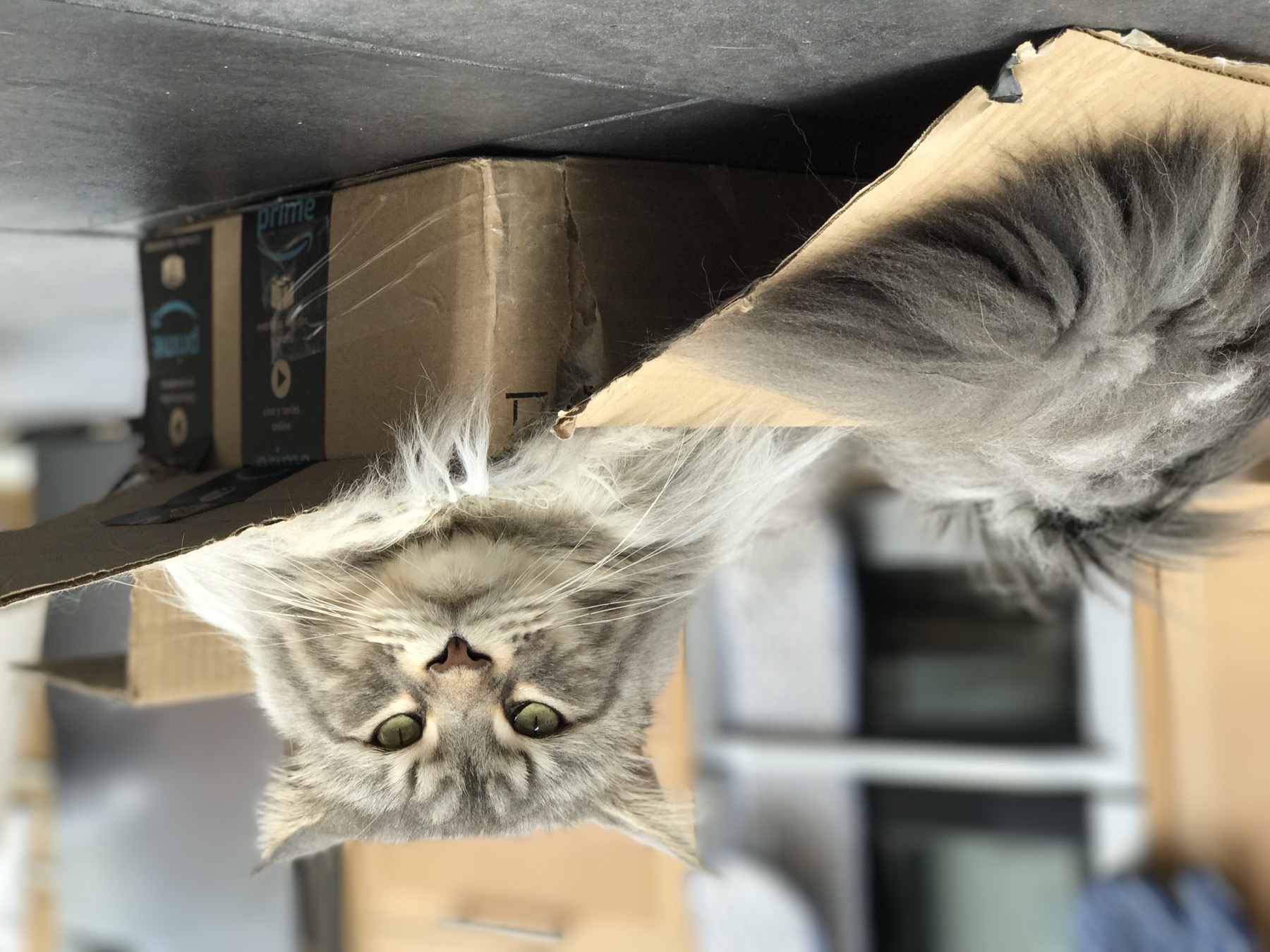
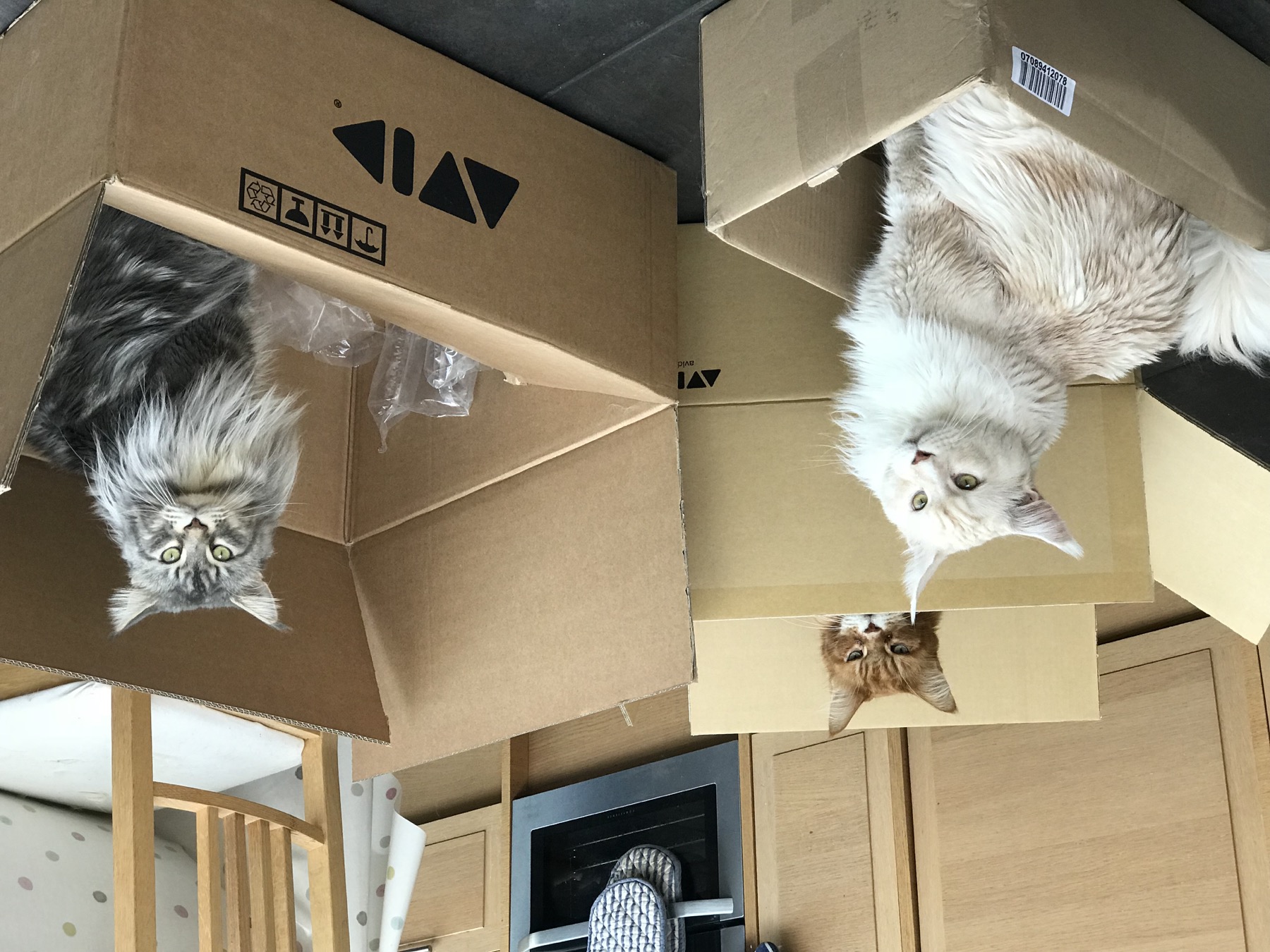
A parcel arrives. Before its contents have found their way to the cupboard, the box has been inspected by my crew in forensic detail. One by one, it is occupied and enthusiastically claimed, until one cat vacates it and the next moves in. It might be too narrow, too shallow or plainly less comfortable than the cat bed nearby. None of this appears to matter.
Boxes are so reliably interesting to cats that it is tempting to treat the whole thing as one of their more charming eccentricities. Yet the appeal makes sense when we stop looking at the box as discarded packaging and begin looking at what it offers from a cat’s point of view.
A small space with clear boundaries
Cats pay close attention to where their bodies are in relation to everything around them. An open room has many possible approaches; a box has walls. Once inside, a cat no longer needs to monitor every direction equally. The space is contained, predictable and easy to understand.
That does not mean a cat in a box is necessarily frightened. Cats choose enclosed places when they are resting, watching, avoiding a disturbance or simply taking a break from company. What matters is the option. A hiding place gives the cat some control over how visible and available they wish to be.
Research in animal shelters supports the value of that choice. In one study, newly arrived cats given a hiding box showed lower stress scores on days three and four and adapted more quickly than cats without one. A later study also found lower stress measures in cats provided with hiding boxes. A home is not a shelter cage, of course, but the principle is useful: somewhere to withdraw can help a cat cope with novelty and change.
A lookout, a launch point and a place to play
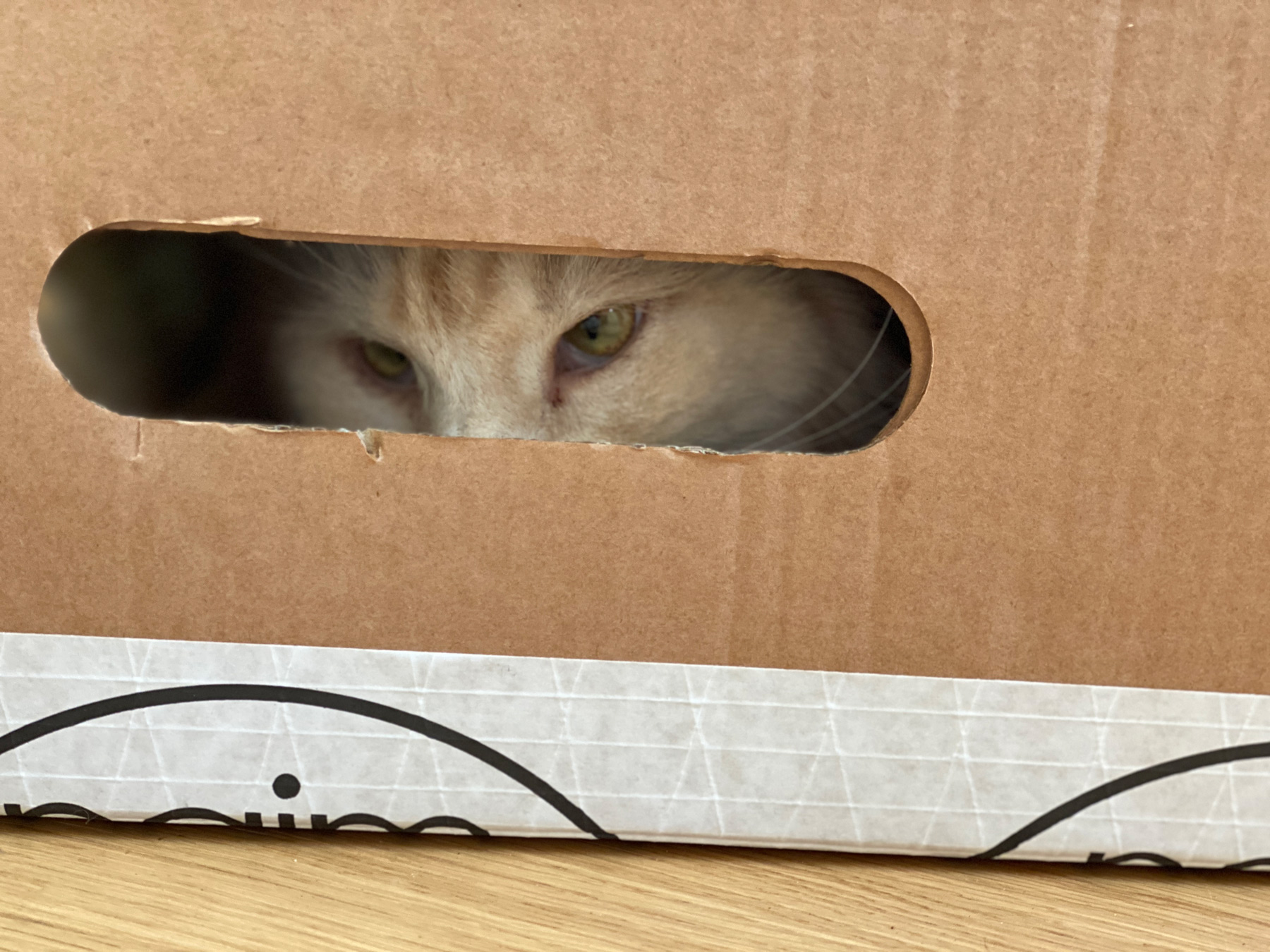
A box can change function in seconds. It is a bed until a toy passes the entrance, a lookout until someone walks by and an ambush point the moment another cat’s tail comes within reach. Cardboard has a little give beneath the paws, holds interesting scents and makes a satisfying surface to scratch, bite and rearrange.
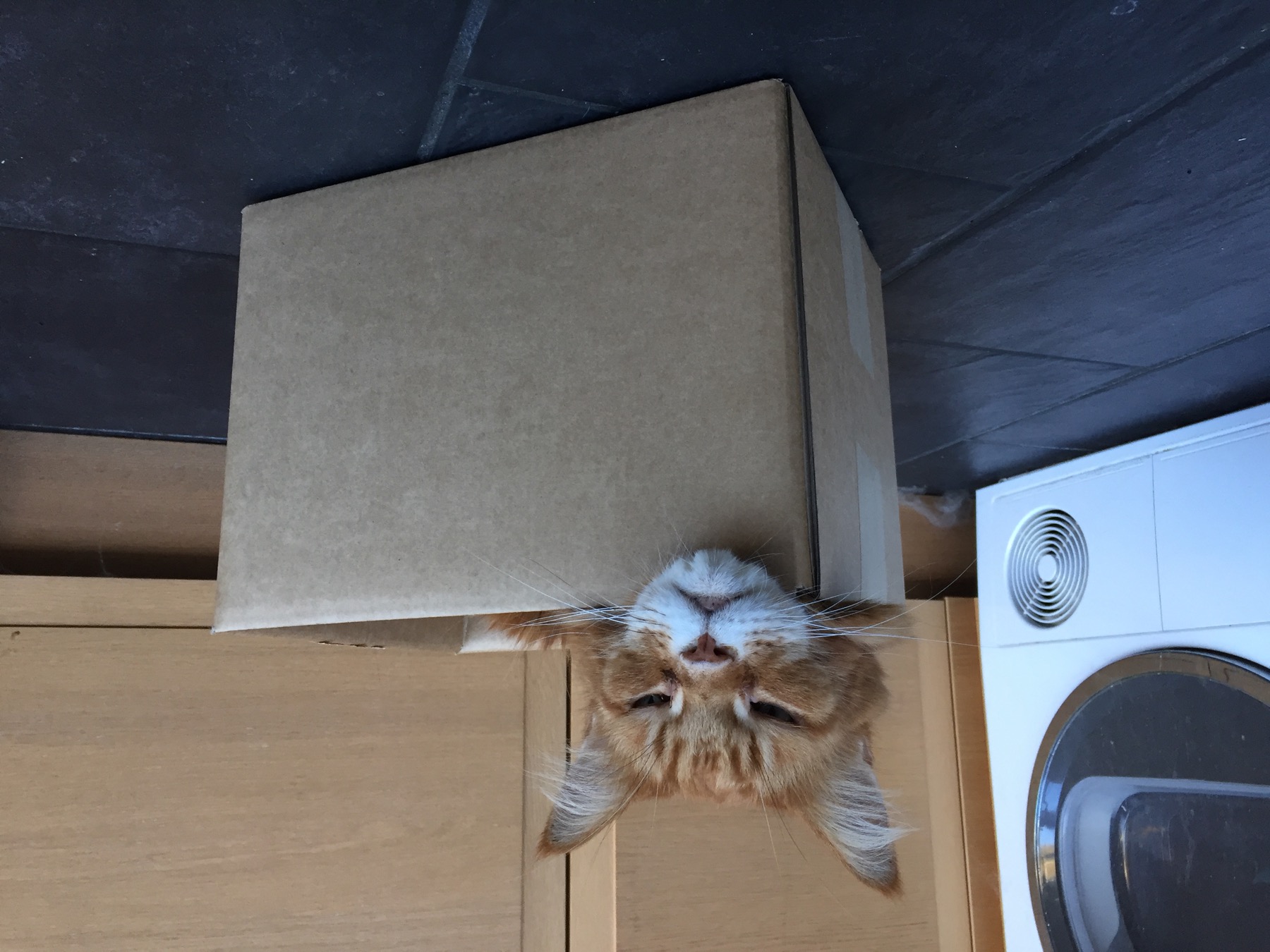
Enclosed spaces can also feel cosy. A close-fitting box reduces the amount of open air around the body and cardboard provides some insulation. For our cats seeking warmth and bodily contact with the edges of a space, the apparently undersized option was exactly right. Chilli, a fairly large Maine Coon, would shoehorn himself into the smallest box, defying gravity to remain upright.
We see a box that is too small. The cat may see four reassuring walls in precisely the right place.
Why the box beats the bed
The familiar joke contains a useful lesson. A bed asks a cat to rest in a particular way and place. A box arrives without expectations. It is new enough to investigate, structured enough to feel secure and versatile enough to sleep, hide or play in.
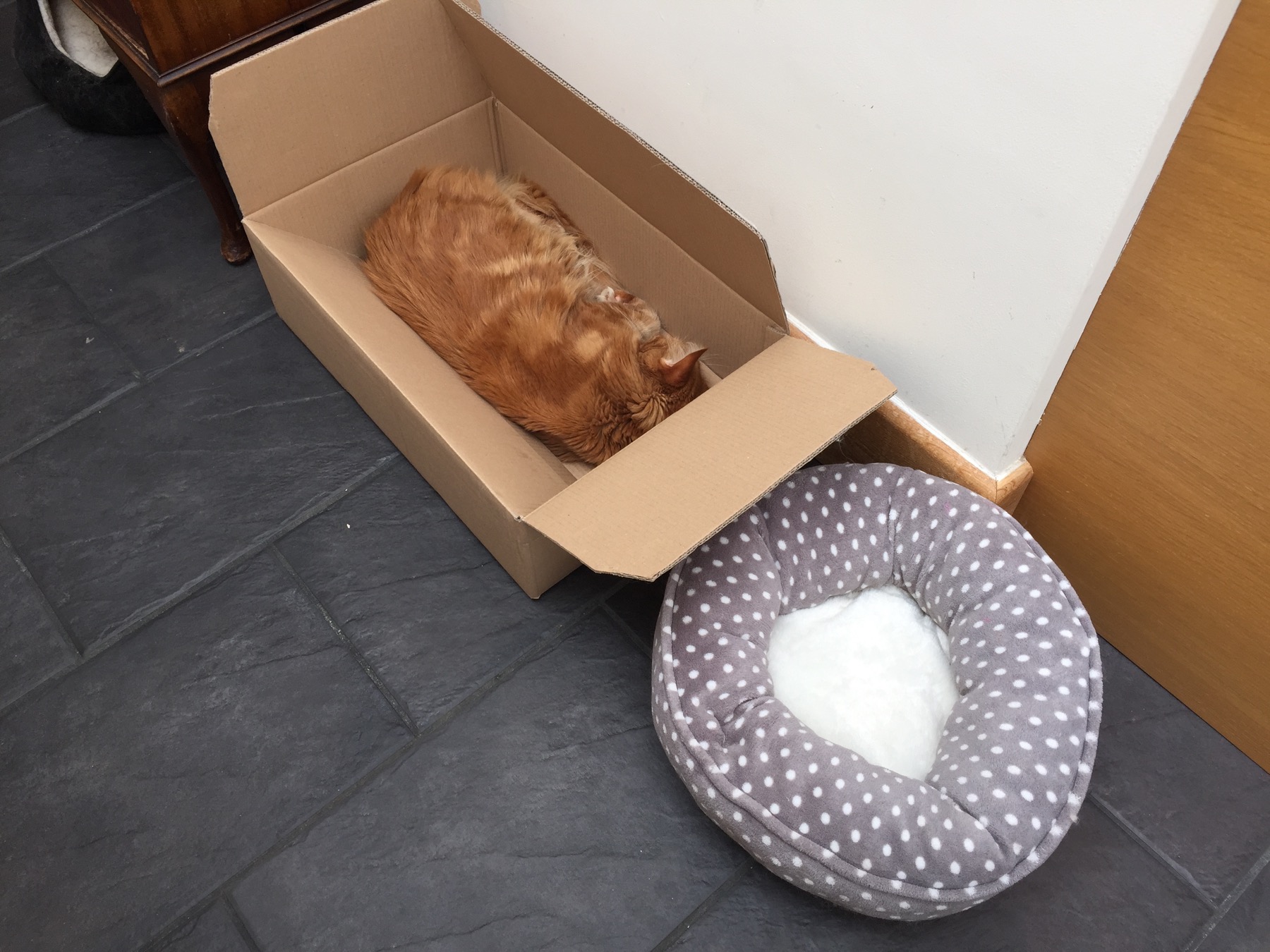
Location matters too. Chilli favoured a modest box in our warm kitchen, near the household’s activity. It seemed more attractive than the purpose made bed positioned right beside it. The box had not defeated the bed on price or softness. It had answered a different set of needs.
Offer choices, then observe
There is no need to turn every delivery into permanent furniture. We regularly left one or more boxes in different places and noticed what happened. Some prefer high sides, others want a shallow tray. One may choose a quiet corner while another wants a box in the middle of family life. In our multi-cat home, several boxes gave each cat the possibility of choosing without having to negotiate for a single prized spot.
For safe box based enrichment:
- Remove staples, loose tape, plastic and packing straps.
- Keep boxes dry, clean and away from heat or open flames.
- Cut openings carefully and check for sharp cardboard edges.
- Give cats more than one exit where another animal could block the entrance.
- Replace damaged boxes, particularly if your cat chews and swallows cardboard.
- Never place or hold a reluctant cat inside.
Boxes are not a replacement for comfortable beds, elevated resting places or other forms of enrichment. They are simply another useful option, and one that costs almost nothing.
The cat gets the final say
The real value of a cardboard box is not that every cat will use it in the same way. It is that the box leaves room for choice. Sleep in it, watch from it, pounce out of it, pull it apart - or ignore it completely.
So when the new bed is overlooked in favour of the packaging, it is probably not a verdict on your shopping. It is information. Your cat has shown you something about the kind of space they wanted at that moment. The most useful response is the simplest one - leave the box there for a while and keep watching.
Sources and further reading
- C.M. Vinke, L.M. Godijn and W.J.R. van der Leij, “Will a hiding box provide stress reduction for shelter cats?”, Applied Animal Behaviour Science, 2014.
- J.J. Ellis, H. Stryhn and M.S. Cockram, “Effects of the provision of a hiding box or shelf on the behaviour and faecal glucocorticoid metabolites of bold and shy cats housed in single cages”, Applied Animal Behaviour Science, 2021.
- International Cat Care, guidance on cat-friendly housing and the importance of hiding places.